When Should You Call for 24/7 Emergency AC Repair in Chandler? A July Heat Survival Guide
When the thermometer hits 115°F in Chandler and your AC quits at 9 PM, you’re not dealing with a comfort problem anymore — you’re dealing with a safety problem. Indoor temperatures in a Valley home can climb past 95°F within a few hours once the cooling stops, especially in homes with western exposure or vaulted ceilings. For seniors, kids, pets, and anyone with a heart or respiratory condition, that’s a real medical risk.
So when does a hot house cross the line from “annoying” to “call somebody right now”? Here’s how we think about it after years of running 24/7 emergency hvac chandler calls across the East Valley.
What Actually Counts as an AC Emergency in July?
Not every weird noise or warm vent is a 2 AM phone call. Some issues can wait until morning without putting anyone at risk. Others can’t. Here’s the honest breakdown.
Call immediately if:
Indoor temps are above 85°F and climbing, especially with elderly family members, infants, or pets in the home
You smell burning, electrical, or chemical odors coming from the air handler or condenser
The breaker for your AC keeps tripping after you reset it once
You see ice on the refrigerant lines or indoor coil combined with no cold air
Water is actively leaking through a ceiling from an attic air handler
The outdoor unit is making a loud grinding, screeching, or banging noise
These aren’t problems that get better overnight. A locked-up compressor, a refrigerant leak, or an electrical short can turn a $400 repair into a full AC Installation if you let it run damaged for another 12 hours.
It can probably wait until morning if:
The AC is running but cooling is just weak (and the house is still under 82°F)
A vent in one room is warmer than others
The thermostat is acting glitchy but the system still responds
You hear a new rattle but performance seems normal
In those cases, set the fan to “on,” close blinds on the west side, and book a regular-hours service call. You’ll save the after-hours fee and still get it fixed quickly.
Why July Failures Are Different in Chandler
Phoenix-area heat puts a unique load on equipment. Your condenser is rejecting heat into 110°F+ outdoor air, which means the refrigerant cycle is already running near its design limits. Add a dirty coil, a low charge of R-410A (or R-454B in newer systems), or a weak capacitor, and the system can’t keep up. It either freezes the indoor coil or trips on high-pressure lockout.
We see the same failure patterns every summer from Sun Lakes up through Tempe and east to Queen Creek and San Tan Valley:
Capacitor failure — the #1 July call. The little can-shaped part that gives the compressor and fan motor their starting kick gives up around 115°F.
Contactor burnout — the relay that powers the outdoor unit pits, sticks, or fails open.
Refrigerant undercharge — a slow leak that ran fine in April can’t keep up in July.
Frozen evaporator coil — usually from a dirty filter or low refrigerant, and it’ll keep refreezing until somebody actually fixes the cause.
Blower motor failure — common in older systems in Mesa and Ahwatukee where ductwork is undersized.
A good emergency tech can diagnose most of these in 20 minutes and get you cooling again the same night.
How to Triage Before You Call
Before you pick up the phone for Emergency AC Repair, spend three minutes on these checks. Sometimes you’ll fix it yourself. Sometimes you’ll give the dispatcher enough info to send the right parts on the truck.
Step 1: Check the thermostat
Sounds dumb, but we’ve driven to Gilbert at midnight to replace dead AA batteries. Make sure it’s set to COOL, the setpoint is below room temp, and the screen is on.
Step 2: Check the air filter
A clogged filter can freeze the coil and shut the system down. If your filter looks gray and fuzzy, swap it. Then turn the thermostat to OFF and the fan to ON for 30-45 minutes to melt any ice on the coil before restarting cooling.
Step 3: Check the breakers
Look at the main panel and the disconnect box next to the outdoor unit. If a breaker is tripped, reset it once. If it trips again immediately, stop. That’s an electrical fault that needs a tech, not another reset.
Step 4: Listen at the outdoor unit
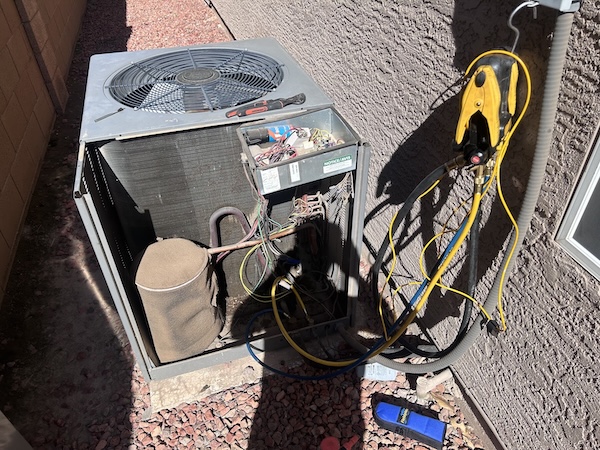
If the fan on top is spinning but you hear a humming from inside, that’s often a failed capacitor. If nothing is happening at all, it’s likely the contactor or a control board issue.
If none of that gets you cooling, it’s time to call.
What to Expect From an After-Hours Call
Honest expectations: emergency rates run higher than daytime rates. That’s the reality of pulling a technician out of bed and stocking a truck with parts at 11 PM. A typical after-hours diagnostic in Chandler runs $125-$200 just for the visit, plus parts and labor for the actual fix.
Common repair ranges we quote on emergency calls:
Capacitor replacement: $180-$320
Contactor replacement: $220-$380
Refrigerant recharge (with leak search): $400-$900+
Blower motor: $600-$1,100
Compressor: $1,800-$3,500 (and worth comparing against replacement)
When the compressor is the failure point on a 12+ year-old system, we’ll have a straight conversation about whether AC Repair makes sense versus putting that money toward a new high-SEER2 system. A 16 SEER2 unit will often pay back the difference in 4-6 summers of Arizona electric bills.
How to Avoid the 2 AM Phone Call Next Year
Most July emergencies are preventable. The capacitors, contactors, and refrigerant issues that fail in 115° heat almost always show warning signs in May — weak amp draw, slightly elevated head pressure, oil residue at a fitting. A spring tune-up catches them when parts are cheap and techs are available same-day.
If you’re in Chandler, Gilbert, Mesa, Sun Lakes, Queen Creek, San Tan Valley, Apache Junction, Tempe, Ahwatukee, Scottsdale, Fountain Hills, or Paradise Valley, get on a maintenance plan before April. We also recommend:
Replace 1" filters every 60 days in summer, 4-5" media filters once a year
Rinse the outdoor condenser coil with a garden hose (power off first) every spring
Have your duct system pressure-tested if rooms cool unevenly — leaky ducts in Arizona attics waste 20-30% of capacity
Consider a hard-start kit on systems older than 8 years to reduce compressor stress
For homes with add-on rooms, casitas, or converted garages that the main system can’t reach, a ductless mini-split is often a smarter fix than oversizing the central unit. That’s a conversation worth having before the heat hits, not during a July breakdown.
Don’t Wait It Out — Call Rush HVAC Services
If your house is heating up right now, don’t tough it out hoping the system kicks back on. Heat-related illness moves fast in a closed Arizona home, and so does damage to a struggling compressor. Rush HVAC Services runs 24/7 emergency hvac chandler service across the East Valley with stocked trucks and techs who can usually be at your door within a couple of hours.
Call us anytime for emergency service, or if it’s not urgent, request a free estimate for maintenance, repair, or replacement. We’ll give you a straight answer on what your system needs — and what it doesn’t. Stay cool out there.