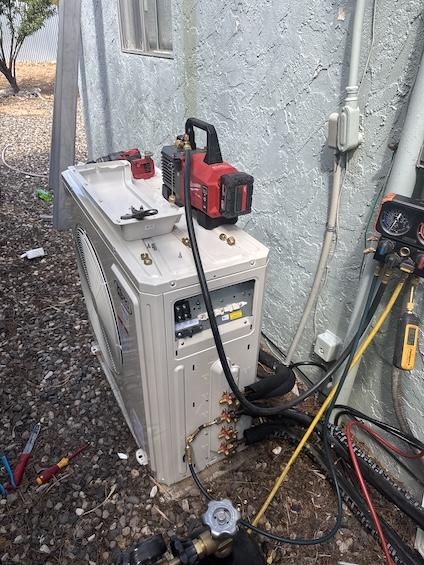
Heat Pumps in Arizona: Do They Work in 100-Degree Summers?
Do Heat Pumps Work in Arizona's 100-Degree Summers? What East Valley Homeowners Should Know
If you're shopping for a heat pump, or you already have one, the question comes up every summer: can a heat pump actually keep a house cool once Arizona hits 100 degrees or more? The short answer is yes. A heat pump cools a home the same way a standard central air conditioner does, and it is fully capable of handling triple-digit East Valley heat when it is sized correctly for the home and properly installed and maintained.
How Does a Heat Pump Cool a House in Extreme Heat?
A heat pump is not a separate category of cooling equipment from a central air conditioner. In cooling mode, it uses the same basic components: a compressor, refrigerant, an outdoor condenser coil, and an indoor evaporator coil. It pulls heat out of the indoor air and moves it outside, exactly the way a traditional AC system does. The difference is what happens in winter: a heat pump has a reversing valve that lets it also pull heat from the outside air and move it indoors, so one system can heat and cool. In summer, though, a heat pump's cooling operation and a central AC's cooling operation are functionally the same process.
Does a Heat Pump Struggle Once Temperatures Pass 100 Degrees?
Any air conditioning system, heat pump or otherwise, has to work harder as the outdoor temperature climbs, because it is moving heat against a bigger temperature difference between inside and outside. A heat pump that is properly sized for the square footage, insulation, and sun exposure of an Arizona home is built to handle that load, including the stretch of afternoons that hit 105 to 115 degrees. Struggles at high outdoor temperatures usually trace back to one of a few causes: the unit is undersized for the home, the ductwork is leaking or restricted, refrigerant levels are low, or the system has gone too long without maintenance. Those are equipment and installation issues, not a limitation of heat pumps as a category.
Heat Pump vs. Central AC: Is There a Real Cooling Difference?
For cooling performance alone, a well-matched heat pump and a well-matched central air conditioner should perform comparably in Arizona heat. The advantage of a heat pump shows up in winter, when it can provide efficient heating without a separate furnace, which is one reason it is a popular choice in East Valley homes that want one system for both seasons. If your main concern is strictly summer cooling, the deciding factors are sizing, ductwork condition, and installation quality, the same factors that determine how well any AC system performs, not whether the equipment is labeled a heat pump or a straight air conditioner.
What Affects Heat Pump Cooling Performance in an Arizona Home?
A handful of factors determine how well any heat pump holds up through an Arizona summer
Signs Your Heat Pump Isn't Keeping Up With the Heat
A few warning signs suggest a heat pump is falling behind on cooling rather than simply working hard on a hot day:
- The house never quite reaches the thermostat setting during peak afternoon heat.
- The system runs almost continuously without cycling off.
- Airflow at the vents feels weak throughout the home.
- Humidity indoors feels noticeably higher than it should.
- Certain rooms stay noticeably warmer than others.
Any of these can point to a sizing mismatch, a ductwork problem, or a maintenance issue rather than a fundamental limit of the heat pump itself.
Heat Pump Service Across the East Valley
Rush HVAC Services is based in Apache Junction and provides heat pump service throughout the East Valley, including Apache Junction, Gold Canyon, Queen Creek, San Tan Valley, Mesa, Gilbert, Chandler, and Tempe.
- Apache Junction
- Gold Canyon
- Queen Creek
- San Tan Valley
- Mesa
- Gilbert
- Chandler
- Tempe
Ready for a Second Opinion on Your Heat Pump?
Rush HVAC Services is a licensed, bonded, and insured contractor (AZ ROC #352820). Whether you are evaluating a heat pump for a new install or want a second opinion on why your current system feels like it is losing the fight against summer heat, the heat pump service page has more detail on the work involved. Ready to see how your heat pump will handle another Arizona summer? Request an estimate from Rush HVAC Services online, or call (602) 370-6847.
Heat Pumps in Arizona Heat, Answered
Can a heat pump cool a house in 100-degree weather?
Yes. In cooling mode, a heat pump works the same way a central air conditioner does, moving heat from indoors to outdoors. A correctly sized, properly installed, and well-maintained heat pump is built to handle Arizona's triple-digit afternoons.
Is a heat pump as effective as a central air conditioner in Arizona?
For cooling specifically, a properly matched heat pump and a properly matched central AC should perform comparably. The real-world difference in performance almost always comes down to sizing, ductwork, and maintenance rather than which type of equipment is installed.
Why does my heat pump seem to struggle on the hottest days?
The most common causes are an undersized unit, leaky or restricted ductwork, low refrigerant, or a system that is overdue for maintenance. These are fixable issues, not a sign that a heat pump can't handle Arizona heat.
How do I know if my heat pump is sized correctly for my home?
A qualified technician evaluates square footage, insulation, window exposure, and ductwork to calculate the correct capacity for your home, rather than relying on the size of the unit you already have. If your system runs constantly without keeping up, sizing is one of the first things worth having checked.
Does Rush HVAC Services install and repair heat pumps?
Yes. Heat pump service is one of Rush HVAC Services' core offerings, available throughout Apache Junction, Gold Canyon, Queen Creek, San Tan Valley, Mesa, Gilbert, Chandler, and Tempe.
What maintenance helps a heat pump handle Arizona summers?
Regular coil cleaning, refrigerant checks, and airflow inspections help a heat pump keep its rated cooling capacity through the hottest months, the same maintenance that benefits any central air conditioning system.
Related Reading
Make Sure Your Heat Pump Is Ready for Another Arizona Summer
Get a straight answer on sizing, ductwork, and performance from Rush HVAC Services.